Why Is My Canadian Citizenship Application Taking So Long?
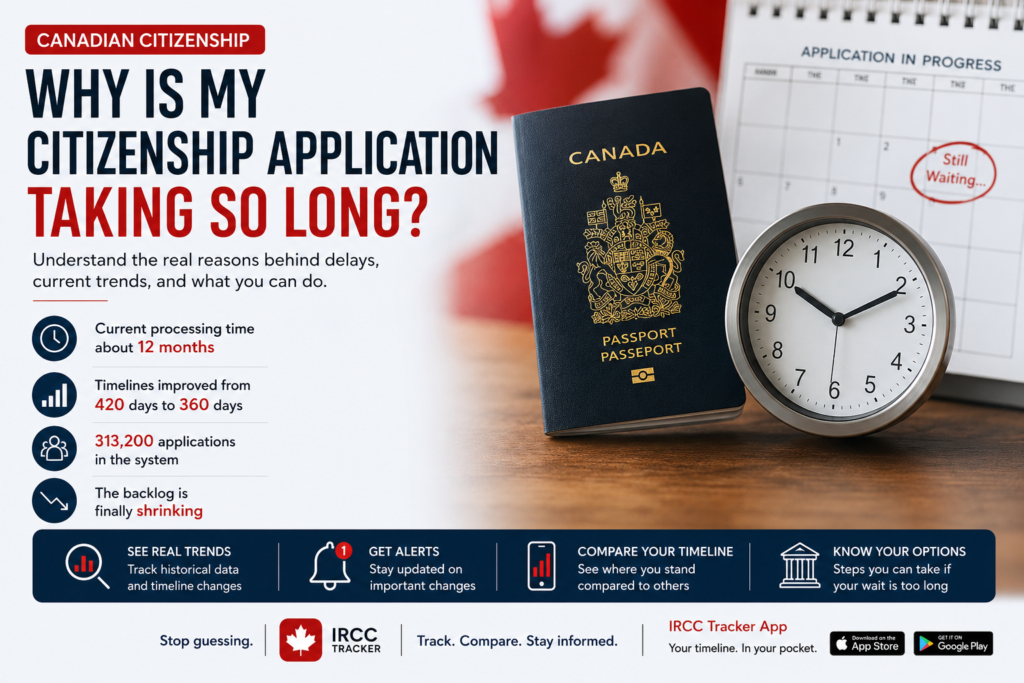
One of the most common questions citizenship applicants ask is also one of the hardest to answer:
“Why is my application taking so long?”
For many applicants, the process feels unpredictable. Some people move from application submission to oath ceremony in less than a year, while others spend months waiting with little visible progress.
The difficult part is that both experiences can still fall within the normal range.
The official IRCC processing time for Canadian citizenship is currently about 12 months. But that number alone does not explain why some applications appear to move quickly while others feel stuck for long periods.
To understand that, you need to look at what has actually been happening inside the system over time.
What IRCC Says
IRCC currently estimates citizenship processing at approximately 12 months.
According to IRCC, this estimate is based on current application volumes, staffing levels, and historical processing data. The estimate is also updated regularly, which means timelines can shift as conditions inside the system change.
For applicants, this is the benchmark most people compare themselves against. But it is important to understand what the number actually represents.
A 12-month estimate does not mean every application will take exactly one year. Some applicants will finish much sooner, while others may take significantly longer depending on timing, background checks, scheduling, and backlog conditions.
Why the Official Timeline Doesn’t Tell the Full Story
If all you know is that citizenship currently takes about 12 months, you are still missing several questions applicants actually care about:
- Are timelines getting better or worse?
- Is backlog pressure increasing or decreasing?
- How do current conditions compare with six months ago?
- Is my timeline actually unusual?
This is the limitation of most processing-time pages online. They repeat the official estimate without explaining what is happening behind it.
For applicants, context matters just as much as the headline number.
What Our Data Shows Over the Past 12 Months
Looking at historical citizenship-processing data reveals a much clearer picture.
Over the past year, processing times increased steadily through late 2025 and into early 2026 before beginning to improve again.
At its recent peak, citizenship processing reached approximately 420 days. The latest figure in our dataset is now 360 days.
That represents a 60-day improvement from the recent high.
This is one of the most important insights in the data. The current 12-month estimate is not simply a stable number — it reflects a system that had become significantly slower before beginning to recover.
How Fast Are Processing Times Changing?
The official processing-time page tells you the current estimate. Historical data also allows you to measure the speed of change.
From the recent peak of 420 days to the latest figure of 360 days, citizenship processing improved by roughly 14%.
That is important because it shows movement, not just level.
A static processing-time estimate can make the system appear stable. Rate of change tells you whether conditions are actually improving or worsening.
How Much Do Citizenship Timelines Vary?
Citizenship processing is often discussed as though it moves on a fixed timeline. In reality, timelines can vary significantly depending on broader system conditions.
In our data, the low point over the past year was around 8 months, while the high point reached roughly 14 months.
That is a spread of approximately 6 months within the same program.
This variability is one of the main reasons applicants feel uncertain. Even if the official estimate says 12 months today, the broader reality is that citizenship timelines have recently moved substantially in both directions.
The Backlog Is Starting to Shrink
Processing times do not exist in isolation. They reflect what is happening in the underlying queue.
According to our latest data:
- Approximately 313,200 applications are currently in the system
- IRCC is processing roughly 8,700 applications per month
- The queue recently declined by approximately 7,100 applications
That last figure is especially important.
For the latest reporting period, more applications were processed than added. In practical terms, this means the backlog is currently shrinking rather than growing.
That aligns with the recent decrease in processing times from 420 days down to 360 days.
What This Means for Applicants Right Now
The most accurate headline remains the same: the official citizenship-processing estimate is about 12 months.
However, the broader trend behind that number is now more favorable than it was earlier in the year.
Current data suggests applicants are no longer looking at a system that is still slowing down. Instead, they are looking at a system that has already begun improving after a period of elevated backlog pressure.
That does not mean every application will finish in exactly 360 days. Individual timelines still vary depending on application details and processing requirements.
But it does mean the overall direction has improved compared with the recent peak.
What a “Normal” Timeline Looks Like Right Now
For many applicants, the real question is not “What is the official estimate?” but “What should feel normal?”
Based on current conditions, around 12 months is the right starting benchmark.
At the same time, historical data shows citizenship timelines have recently ranged between roughly:
- 8 months at the low end
- 14 months at the high end
That context matters because two applicants discussing timelines online may both be correct — they may simply be describing different periods within the processing cycle.
What To Do If Your Citizenship Application Is Taking Longer Than Expected
Longer processing times do not automatically mean there is a problem with your application. Citizenship timelines can vary significantly depending on background checks, application volume, scheduling delays, and overall backlog conditions.
However, if your timeline is moving well beyond the current normal range, there are several reasonable steps you can take.
1. Compare Your Timeline Against Current Trends
The first step is understanding whether your application is actually outside the normal range.
Right now, the official citizenship-processing estimate is about 12 months, but historical data shows recent timelines have ranged from approximately 8 to 14 months.
If your application still falls within that broader range, a lack of updates may not necessarily indicate an issue.
This is where historical tracking becomes useful. Looking only at the current official estimate does not show how timelines have changed over time or how your application compares with recent processing conditions.
2. Check Your Application Status Carefully
Before contacting IRCC, make sure there are no missing requests, unread messages, or incomplete steps in your tracker or online account.
In some cases, delays are caused by missing documents, additional verification requests, or communication that was overlooked.
3. Submit an IRCC Web Form
If your application appears significantly outside normal timelines, submitting an IRCC web form can be a reasonable next step.
A web form allows applicants to:
- Request a status update
- Provide additional information
- Notify IRCC about changes or concerns
While responses are not always immediate, this is one of the standard ways applicants follow up on delayed applications.
4. Call IRCC
Some applicants also choose to contact IRCC directly by phone, especially if their application has gone well beyond the expected range or if they need clarification about a specific stage.
Call centre agents typically cannot speed up processing, but they may be able to confirm whether:
- The application is still active
- Additional documents are required
- There are outstanding issues on the file
5. Contact Your Member of Parliament (MP)
If your application has experienced a very long delay, some applicants choose to contact their local Member of Parliament for assistance.
MP offices can sometimes request status information from IRCC on behalf of constituents. This does not guarantee faster processing, but it may help provide additional clarity in cases where applications have been delayed far beyond normal timelines.
6. Keep Expectations Grounded
One of the most difficult parts of the citizenship process is uncertainty. Long periods without updates are common, and applications often appear inactive while internal processing continues behind the scenes.
That is why understanding broader trends is important. A timeline that feels unusually slow in isolation may still fall within the normal range once current backlog conditions and historical processing patterns are taken into account.
Questions Applicants Usually Have
Is 12 months actually realistic right now?
Yes. As a current benchmark, 12 months is realistic because it matches both the official IRCC estimate and the latest figure in our data.
What makes that more useful is the trend behind it: today’s estimate is lower than the recent peak.
Why does my application feel stuck?
Citizenship applications often go through long stretches where there appears to be little visible movement.
What feels like a stall can simply be part of a larger queue or an internal processing stage that is not obvious from the outside.
How much can timelines differ between applicants?
Quite a lot. Our data shows a range from roughly 8 months at the low end to approximately 14 months at the high end over the past year.
That alone is enough to create very different applicant experiences within the same program.
Are things getting faster or slower right now?
Based on the latest data, conditions are currently improving rather than worsening.
Processing times have decreased from 420 days to 360 days, while the queue has started shrinking.
When can I actually track my application in more detail?
Detailed status tracking usually becomes available after receiving your acknowledgement of receipt (AOR).
Before that stage, there is often very little visibility into where an application stands.
Final Answer
As of April 2026, the official processing time for Canadian citizenship is approximately 12 months.
What makes that number more meaningful is everything around it. Historical data shows citizenship timelines rose to approximately 420 days, have since improved to 360 days, and are now moving in a better direction as the backlog begins shrinking.
The official estimate tells you where the system is today. Historical data helps explain how it got there — and where it appears to be heading.
Why Tracking Change Matters
The difference between a useful processing-time page and an unhelpful one usually comes down to context.
A single number can tell you today’s estimate. A trend tells you whether the system is improving, whether backlog pressure is easing, and whether expectations should be changing.
That is the value of historical tracking.
IRCC Tracker App helps applicants follow processing-time trends, backlog movement, and future changes over time — instead of relying on a single snapshot.