How Long Does It Take to Get Canadian Citizenship? (May 2026)
about 12 months.That figure comes directly from IRCC. But on its own, it doesn’t tell you how timelines are changing, whether things are improving, or how today’s applicants compare to those who applied earlier.To understand that, you need to look beyond a single number and look at how processing times have actually moved over time.
What IRCC Says
As of now, IRCC’s official processing time for citizenship applications is
approximately 12 months.
IRCC calculates this based on current application volumes, processing capacity, and recent historical data. It represents how long it may take to process most applications submitted today.
That number is accurate — but it is also a snapshot. It does not show whether timelines are increasing, decreasing, or staying stable.
Why the Official Timeline Doesn’t Tell the Full Story
Processing times change regularly. Over the past year, citizenship timelines have moved significantly — both up and down.
If you only look at the current estimate, you miss the bigger picture:
- How much timelines have recently increased or decreased
- Whether backlog pressure is building or easing
- How current applicants compare to earlier ones
This is where historical data becomes more useful than a single estimate.
What the Data Shows Over the Past 12 Months
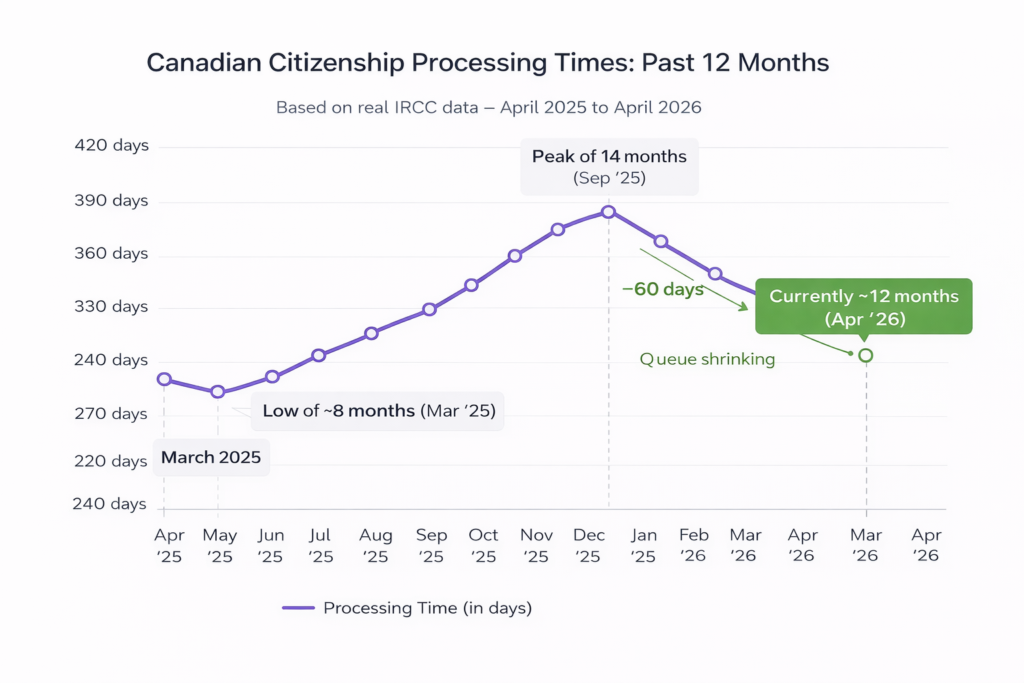
Looking at historical processing time data reveals a clear shift over the past year.
Citizenship timelines reached a high of 420 days in early 2026. Since then, they have fallen to 360 days in the most recent update.
That represents a 60-day improvement from the recent peak.
This change is significant. It shows that current timelines are not just sitting at 12 months — they are actively adjusting after a period of slower processing.
A Clear Pattern: Increase, Peak, Then Decline
The past 12 months follow a consistent pattern.
Processing times were lower earlier in 2025, sitting around 8 to 11 months. They then increased through late 2025, eventually peaking in early 2026.
Since that peak, the most recent updates show a steady decline.
This matters because it places today’s processing time in context. The current 12-month estimate reflects a system that has already begun correcting after a slower period.
How Fast Are Processing Times Changing?
One of the most useful ways to understand the system is to look at how quickly timelines are shifting.
In the most recent updates:
- Processing time dropped from 420 days to 360 days
- This is a reduction of roughly 14% in a short period
IRCC does not publish this rate of change, but it is one of the clearest indicators of whether conditions are improving or worsening.
The Backlog Is Starting to Shrink
Processing times are closely tied to the number of applications in the system.
Current data shows:
- ~313,200 applications in the queue
- ~8,712 applications processed per month
- A recent change of –7,100 applications
The negative change is important. It means that, at least in the latest update, more applications were processed than added.
When that happens, backlog pressure decreases — which is often followed by improvements in processing times.
How Much Do Citizenship Timelines Vary?
Citizenship processing is not fixed. Over the past year, timelines have varied significantly.
Our data shows:
- A low of approximately 8 months
- A high of approximately 14 months
That is a spread of up to 6 months within a single year.
This variability is one of the main reasons applicants experience uncertainty — and why a single official estimate often feels disconnected from real timelines.
What Direction Are Things Moving Right Now?
Looking at the most recent updates together:
- Processing times have decreased in consecutive updates
- The overall queue has declined
- Processing volume remains steady
Taken together, these signals point in the same direction:
the system is currently improving rather than slowing down.
—
What This Means for Applicants
The official benchmark remains clear: around 12 months.
However, the broader data suggests that current timelines are coming down from earlier highs, and that backlog pressure has eased compared to recent months.
Individual timelines will still vary depending on application details, but the system as a whole is no longer trending in a slower direction.
—
Final Answer
As of now, Canadian citizenship processing time is approximately 12 months (360 days).
What makes this more meaningful is the trend behind it: timelines increased through late 2025, peaked at 420 days, and have since improved by 60 days, with the backlog beginning to shrink.
—
Why Tracking Changes Over Time Matters
IRCC provides a current estimate, but it does not show how that estimate is evolving.
Tracking historical data makes it possible to see:
- Whether timelines are improving or worsening
- How quickly changes are happening
- How current conditions compare to previous months
That context is often more useful than the headline number itself.
IRCC Tracker App is built around this idea — helping applicants follow trends over time rather than relying on a single snapshot.